If a nor'easter took out your dock this winter, do you actually know what you'd be allowed to rebuild? Not what you assume, not what the seller who owned the place in 1975 was allowed to build, but what Camden's rules say today. For a lot of waterfront owners in town, the honest answer changed in the last six months, and most people haven't caught up yet.
Camden made real, substantive changes to how it regulates shoreline development this year. Some of it happened at Town Meeting this spring. Some of it happened through a separate ballot vote on the town's Harbor and Waterways Ordinance. Together, the changes touch nearly every waterfront transaction that's likely to close in Camden over the next year, whether the property in question is a modest one-story cottage on a quiet cove or a shingle-style estate on Bay View Street with a deep-water dock. The rules didn't just get stricter. They got more specific about a question that used to be answered loosely: how much of what's already there can you keep, and how much of it can you change.
What actually changed this year
Camden's Planning and Code Enforcement office lists two current initiatives on its site: the zoning amendments adopted June 9, 2026, and a moratorium ordinance prohibiting the hardening or armoring of coastal shorelines. Here's what's in each, in plain terms:
- A 180-day moratorium on shoreline hardening took effect April 7, 2026, according to the Town of Camden. For that period, the town paused new riprap, seawalls, and similar armoring while it reviews its own permitting process. If you were counting on a straightforward seawall repair to stabilize an eroding bank before listing, that timeline just got less predictable.
- Stamped plans and third-party review for shoreland projects. The June amendments now require a licensed design professional's stamped plans for certain work in the Shoreland Overlay Zone, plus a stamped as-built site plan and certificate of compliance before the town issues a certificate of occupancy. The Planning Board also gained the authority to require third-party technical review of an application, at the applicant's expense, when it wants a second set of eyes on the engineering.
- An updated definition of "coastal wetland," brought into line with a newer state standard, which can shift which parcels or portions of parcels fall inside the regulated shoreland zone.
- New rules for Camden Harbor itself. In a separate ballot measure on the town's Harbor and Waterways Ordinance, voters approved amendments by a wide margin, 1,802 to 313. Piers that need significant repair or replacement due to damage now have to be raised to eight feet above mean high water where practicable, with structural reinforcement built in to account for future sea level rise, according to Penobscot Bay Pilot. The same amendments added a permit requirement for land-attached floats in the harbor, along with any moorings or structures tied to them.
None of this is theoretical for anyone with a transaction in motion. A buyer under contract on a place with an aging dock now needs to ask whether a "repair" crosses into "significant repair or replacement," because that's the line that triggers the new height requirement. A seller planning to firm up a crumbling bank before putting a property on the market needs to know the moratorium clock started April 7.
The part that surprises people: small can beat big
Here's where it gets genuinely counterintuitive, and it's the piece of this story most waterfront buyers miss entirely.
For legally nonconforming structures, a recent statewide amendment changed the math: it's now based on the structure's footprint, the actual ground area the building and its attached decks and patios cover, with owners able to choose between 30 percent of that footprint or a flat 1,000 square foot allowance, whichever is larger, as MPM Law explains.
That sounds like a technical adjustment. It isn't. A rambling two-and-a-half-story camp with a large footprint and a lot of interior volume actually loses expansion room under the new rule, because floor area and volume no longer count toward what you're allowed to add. A modest single-story 1940s cottage with a small footprint, on the other hand, often gains room, because the flat 1,000 square foot allowance can exceed what 30 percent of its old floor area used to give it. The rule was written to be neutral. In practice, it favors the smaller, older, single-story building over the larger, multi-story one, on the same size lot, in the same shoreland zone.
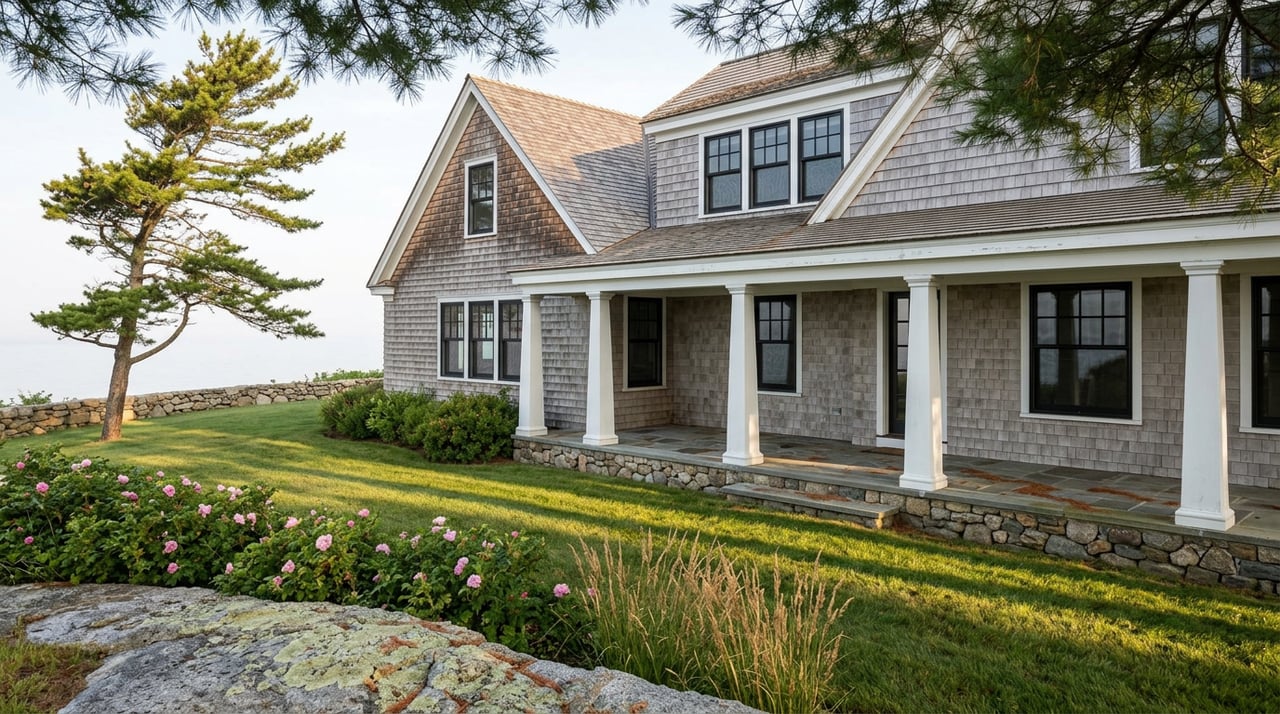
This matters directly in Camden's current inventory. Camden's waterfront listings span a wide range, from unassuming cottages to a five-bedroom shingle-style estate on Bay View Street, one of the town's most sought-after streets, sitting on more than three acres with over 200 feet of shorefront and a deep-water dock. Two buyers looking at very different price points might assume the larger, more finished home comes with more room to grow. Under the current footprint rule, that assumption can be exactly backward. If you're evaluating a Camden waterfront property with future renovation in mind, the footprint of the existing structure, not its square footage or its price tag, is the number that tells you what you can actually do with it.
"A structure located next to the water for convenience does not meet the test of operational necessity."
That line, from the Maine DEP's own guidance on the Mandatory Shoreland Zoning Act, is worth sitting with if you're picturing a boathouse or a pool house close to the shore. Proximity to water for its own sake doesn't earn an exception. Only uses that genuinely require direct water access, like a pier or a dock, get that treatment.
The septic question nobody wants to deal with in December
According to the Press Herald, Maine has required a septic system inspection before the sale of any property in the coastal shoreland zone since 2007. If the system can't be inspected before closing because of frozen ground or snow cover, the buyer gets up to nine months after closing to get it done, as Maine Realtors explains, and any malfunction found has to be repaired or replaced within a year of the transfer, as Watchic Lake explains.
That sounds manageable until you're the buyer trying to schedule a certified inspector during a Camden winter, or the seller who assumed the requirement would just sort itself out at the closing table. It won't. The practical fix is simple: if you're selling waterfront in Camden and there's any chance your closing lands between November and April, get ahead of it. A pre-listing septic inspection costs far less than a surprise that stalls a deal in February.
What this means if you're on either side of the table
Put these pieces together and the shift in Camden's waterfront market this year isn't really about price. It's about what a given structure is legally allowed to become, and that answer now depends on details that didn't used to matter as much: the exact footprint of the existing building, whether a dock repair counts as "significant," whether a bank stabilization project falls inside or outside the current moratorium window, and whether a septic inspection has already happened or still needs to.
For sellers, that means a smaller, older cottage might be worth positioning around its expansion potential rather than apologizing for its size. For buyers, it means the home inspection contingency period needs to include a real conversation with the town's code enforcement office, not just a structural walk-through. Waterfront in Camden hasn't stopped being valuable. It's just gotten more precise about who benefits from that value and how.
A few questions worth asking before you sign anything
Does the shoreline hardening moratorium affect a property I'm trying to sell right now? Only if you or a buyer are planning new riprap, a seawall, or similar armoring work during the 180-day window that started April 7, 2026. It's worth confirming whether any planned work can proceed before you count on it happening this year.
Can I wait until after closing to handle the septic inspection? Only if weather genuinely prevents it beforehand, and even then you have nine months, not an open-ended window. If your closing is scheduled for late fall or winter, it's worth having the inspection done well before you list.
Does a mooring or float I've had for years need a new permit? The Harbor and Waterways Ordinance amendments added a permit requirement specifically for land-attached floats and any associated moorings or structures in Camden Harbor. If you're not certain whether yours predates the requirement or falls under it now, Camden's harbormaster is the right first call.
Camden's waterfront market rewards buyers and sellers who understand these mechanics before they're three weeks into a transaction. If you're weighing a purchase or getting ready to list on the water, Mary Libby Living Real Estate can walk through what your specific property's footprint, setback status, and timeline actually allow. Schedule a free consultation before you make an offer or sign a listing agreement, not after.
This article is general information, not legal, tax or financial advice. Consult a qualified professional about your situation.